Passive markers use magnetic antenna technology. They consist of an inductive coil acting as an antenna and a capacitor, forming an LC circuit that resonates at an exact operating frequency. Tempo Communications markers are passive antennas — they contain no power source or active components, and draw all their energy from the locator’s magnetic field.
This non-intrusive technology can locate all pipelines regardless of material. It improves the quality of any pre-work survey, helps reduce confusion and improves worksite safety.
The marker housing is made of high-density polyethylene, the same material used for most buried utility equipment. It is rugged, waterproof, and resistant to chemicals and temperature extremes.
Markers are interoperable as they operate at industry-standard frequencies:
• Water: 145.7 kHz
• Telecom: 101.4 kHz
• Gas: 83.0 kHz
Detection is inductive — no physical contact from the surface is required.
Marking your pipeline network costs less than 1% of total project cost — far less than the cost of exposing a single pipe.
By deploying markers and using complementary solutions (locators and GPS/GIS databases), you can gradually map your network, recording GPS coordinates (X, Y) and network depth (Z).
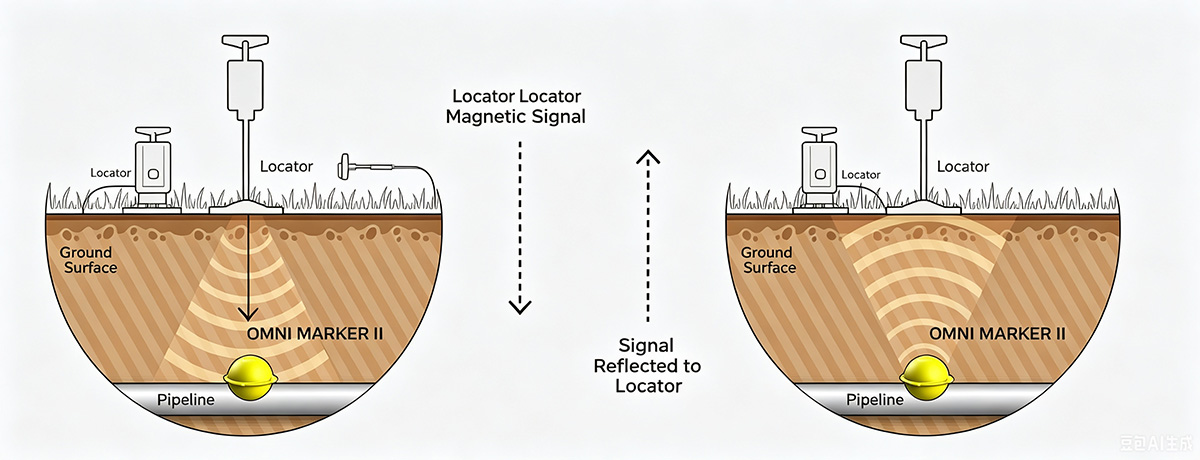
Resonant markers are best placed on top or the side of the pipe, but orientation must be consistent.
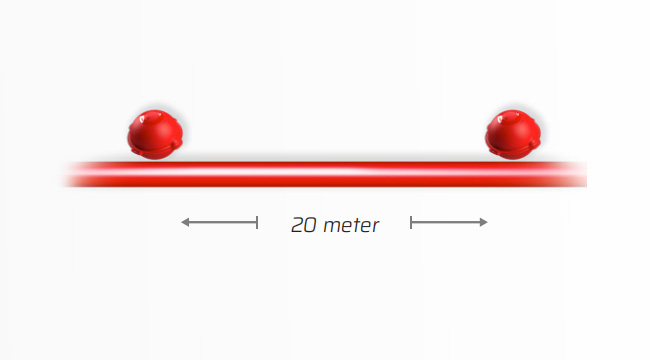
For straight pipeline sections, place one marker every 20 meters along the route to ensure continuous and accurate positioning.
• For bend radius less than 1 meter (most common connections): place 2 markers.
• For bend radius greater than 1 meter: place 3 markers for precise positioning.
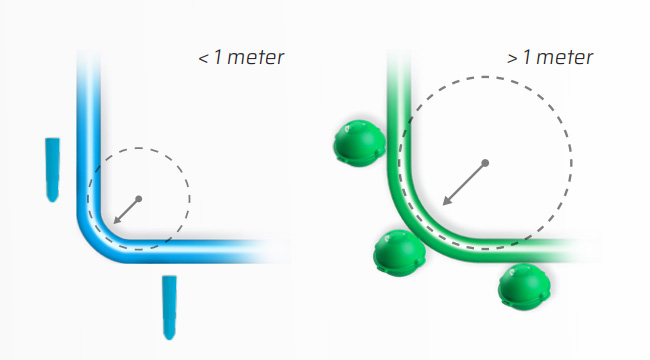
If there is a lateral branch connection, place one marker as close to the junction as possible. This marker identifies the starting point of the branch pipeline connected to the main network.


 phillip.bai@cobinet.cn
 13586806979
 Unit 1, Building 4, No. 209, Lane 520, Tongning Road, Jiangbei District, Ningbo City
Copyright © 2026 Cobinet All Rights Reserved. Designed & SEO by followala.cn Sitemap | XML

 Languages
 Home
Home Products
 Company
 Contact Us